📊 1. The Trap of Returns: The Scary Truth Behind +50% and -50%
Accustomed to simple arithmetic, our brains often make critical errors when intuitively calculating investment returns. Many people fall into the illusion that “making a 50% profit and then taking a 50% loss results in breaking even.” However, the reality reflected in an actual portfolio is entirely different.
Let’s assume you started investing with a principal of 1 million KRW.
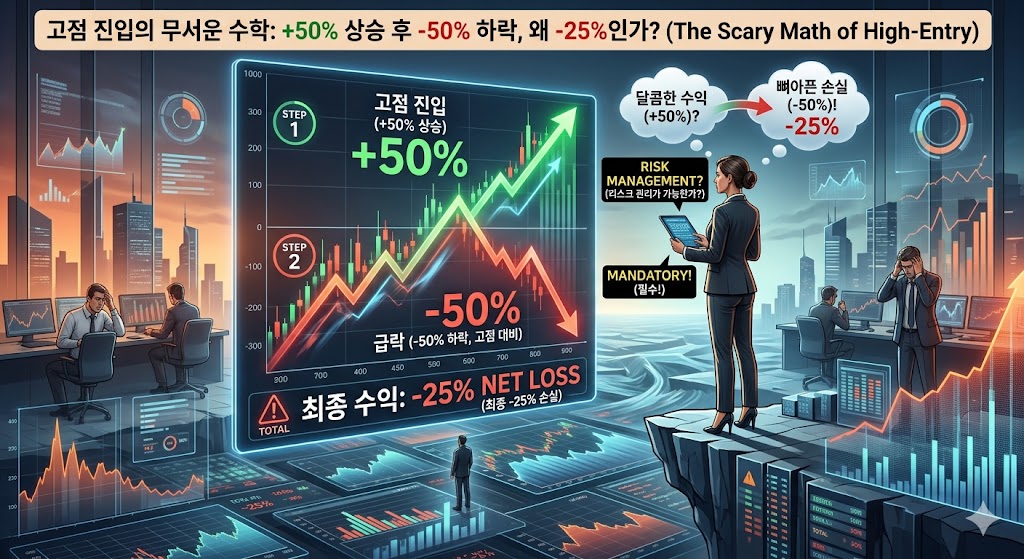
Case A: A Crash Following Sweet Profits
- Profit after initial entry: 50% rise ➔ Valuation: 1.5 million KRW
- Drop the next day: 50% decrease from the peak ➔ Valuation: 750,000 KRW
- Final Return Rate: -25%
Case B: A Rebound Following Painful Losses
- Loss after initial entry: 50% drop ➔ Valuation: 500,000 KRW
- Rise the next day: 50% increase from the bottom ➔ Valuation: 750,000 KRW
- Final Return Rate: -25%
Regardless of the order, once your account hits a deep valley of -50%, the rate of return required to recover is not 50%, but 100%. This is precisely the “Curse of Compounding” brought on by volatility.
⚠️ 2. Entering at the Peak: The Sharp Blade Behind the Hype
Stocks that have surged over 100% in a short period are characterized by massive market liquidity and trading volume. Jumping onto such a stock to chase an additional 50% gain is undoubtedly thrilling and seductive. It is a logical opportunity for return-seeking investors to pursue.
However, investing at the peak is akin to dancing on the edge of a cliff.
- Maximized Volatility: At the peak, buying and selling forces collide violently, causing stock prices to fluctuate by dozens of percent within a single day.
- Acceleration of Downward Pressure: Once profit-taking selling begins, even a small piece of bad news can trigger panic selling, resulting in a -50% loss in an instant.
As the previous mathematical examples demonstrated, a 50% gain and a 50% loss at the peak have entirely different impacts on your portfolio. A single failure can erase all accumulated profits in one fell swoop.
🛡️ 3. Conclusion: Risk Management is a ‘Prerequisite’, Not an ‘Option’
Naturally, generating returns is crucial in investing. If one avoids risk entirely, bank deposits remain the only viable alternative.
However, the core point I urge you to consider right now is this:
Before entering a position blinded by potential profit, do you possess the “stop-loss discipline” and “position sizing” capability required to endure this volatility and protect your capital?
Entering at a high point is not inherently wrong; many successful traders generate substantial returns through trend following. However, they enter such positions only because they are capable of executing strict mechanical stop-losses and comprehensive risk management.
If you buy at the peak without a contingency plan for a downward scenario, relying solely on the vague expectation that “it feels like it will go higher,” it is no longer investing—it is gambling, akin to betting on a coin flip.
Please bear in mind that successful investing depends less on “how much you earn” and far more on “how much you manage not to lose.”
zeroro9에서 더 알아보기
구독을 신청하면 최신 게시물을 이메일로 받아볼 수 있습니다.
